

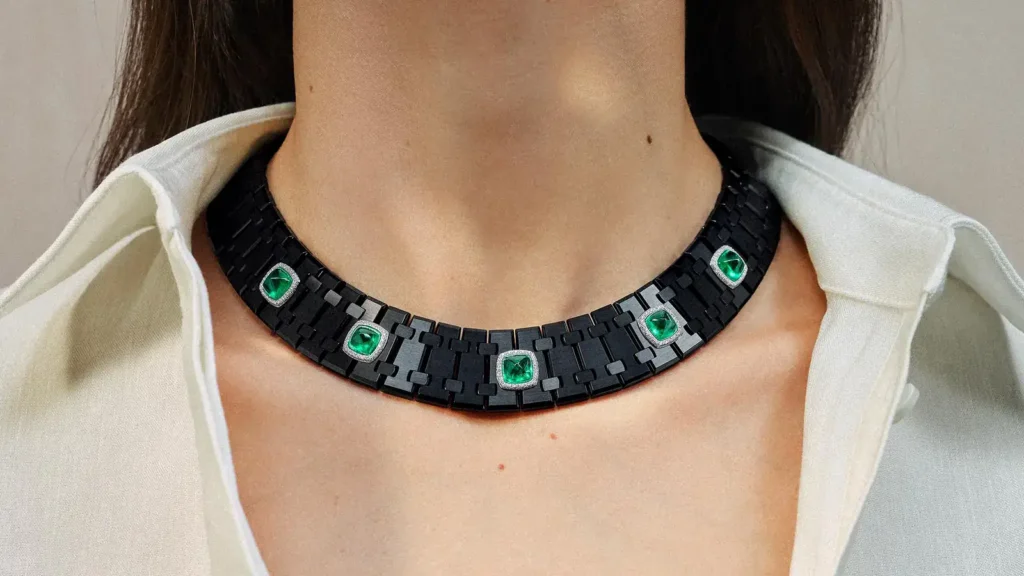
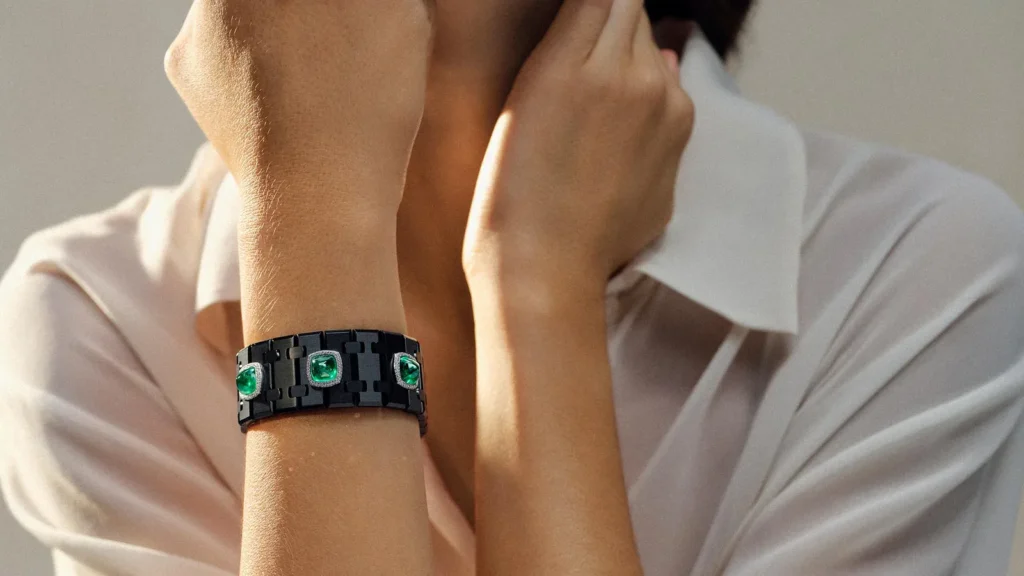
Before its Paris unveiling, Audemars Piguet privately presented the collection in Bangkok, Zurich, and Saint-Tropez. The first 19 creations, developed with Nathalie Barzilay, are divided into three families inspired by the Vallée de Joux, the Swiss Jura valley that has been home to the manufacture since 1875. Risoud Eclipse draws from the immense Risoud Forest and the region’s centuries-old fascination with the night sky, translating the atmosphere of an eclipse into a dramatic pairing of black PVD-treated titanium, 18-karat white gold, diamonds, and sugarloaf emeralds. Five emeralds totaling approximately 16.5 carats illuminate the necklace, while three stones totaling around 12 carats anchor the matching cuff, each surrounded by brilliant-cut diamonds. Their carefully polished conical surfaces allow light to enter from multiple directions, giving the stones a remarkable sense of depth and movement.
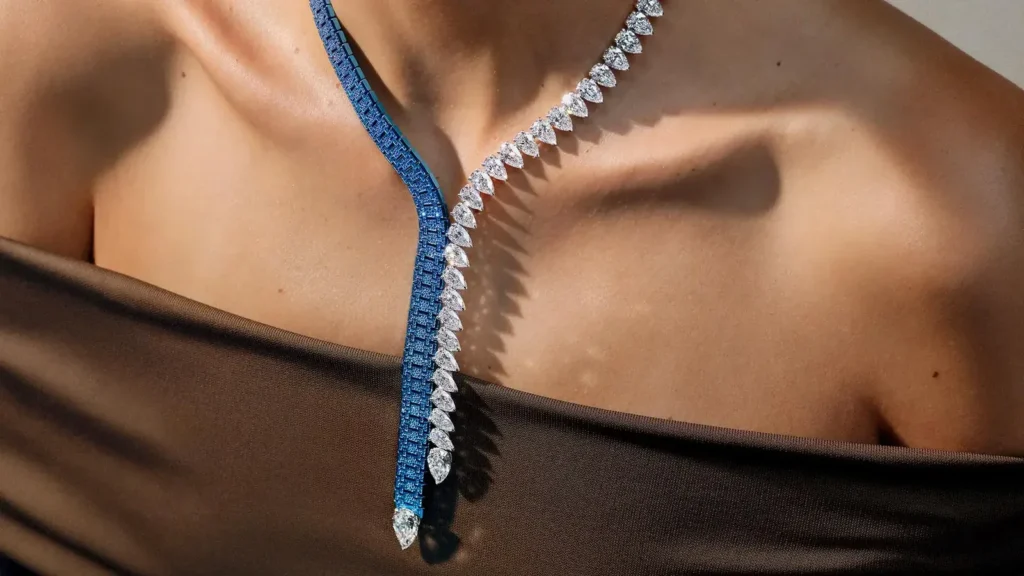
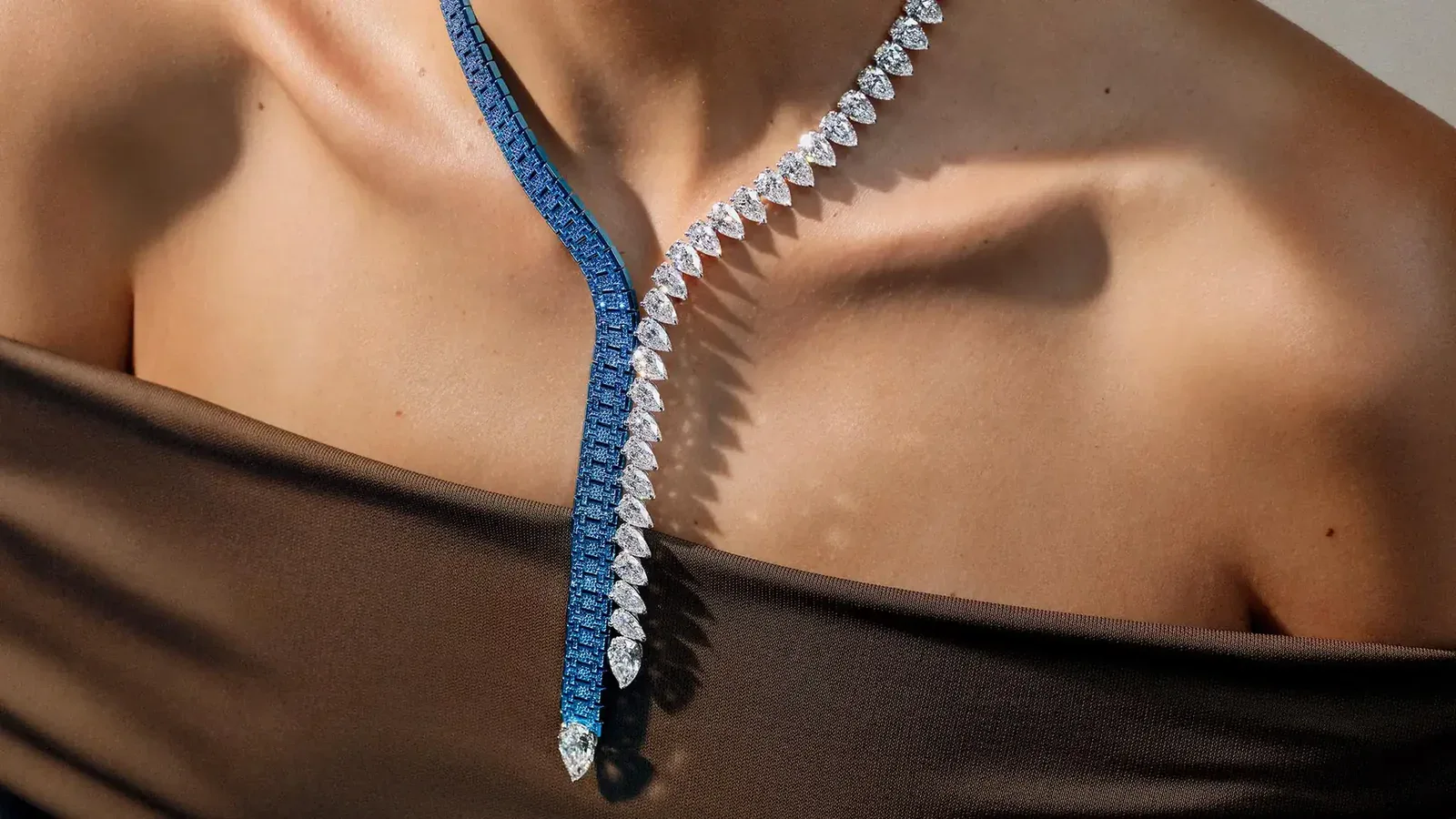
At the collection’s most spectacular end is Dream of Joux, a high-jewelry interpretation that turns the Royal Oak bracelet into a canvas for extraordinary color and brilliance. Its tie-style necklace combines anodized blue titanium with 18-karat white gold and 42 pear-shaped diamonds of approximately 1.5 carats each, totaling roughly 63 carats, alongside two additional pear-shaped diamonds weighing five and three carats. The titanium links are entirely covered with 1,670 blue sapphires in a snow setting, creating an intensely saturated surface. Matching drop earrings add eight more pear-shaped diamonds totaling approximately 15 carats.
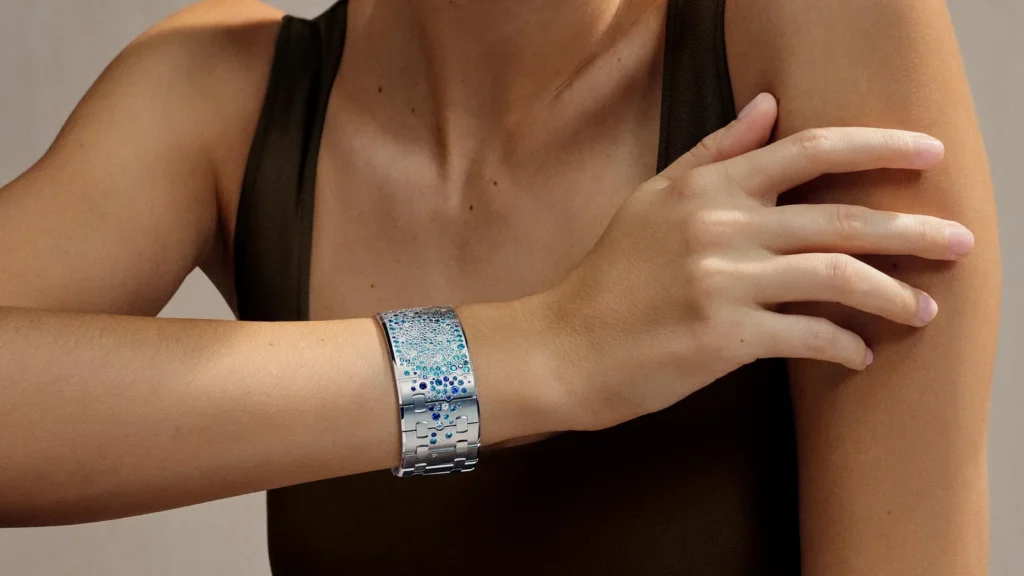
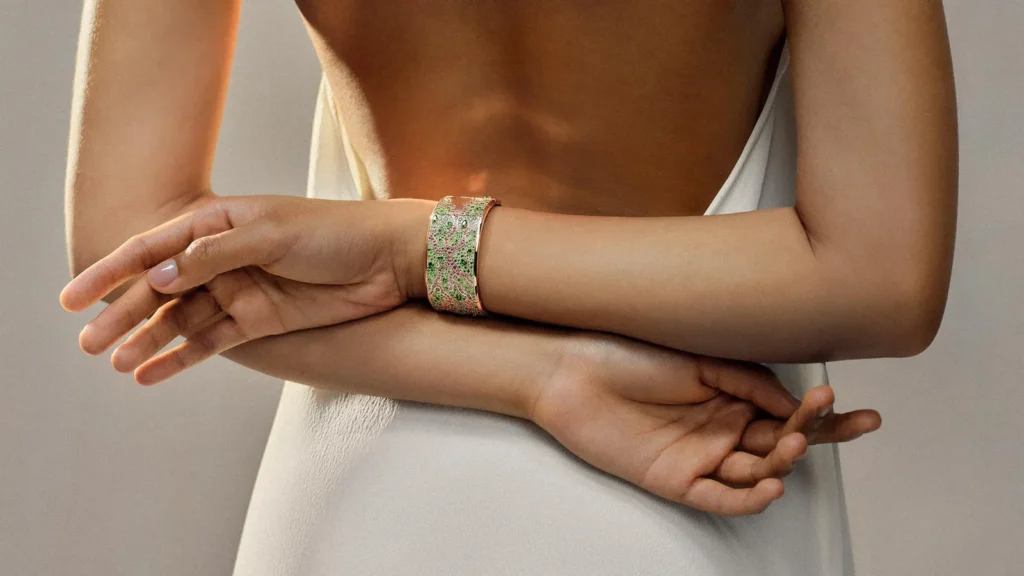
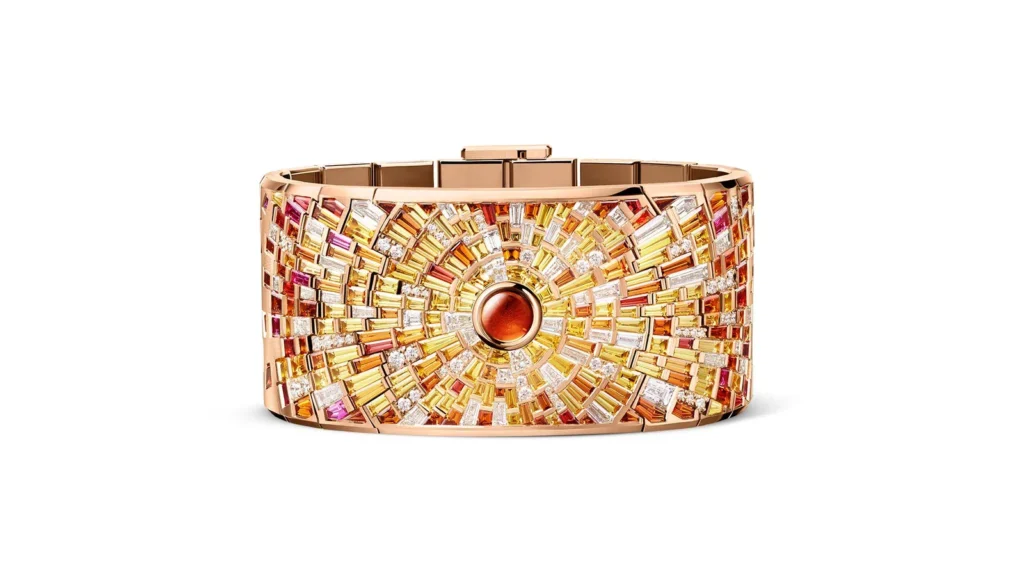
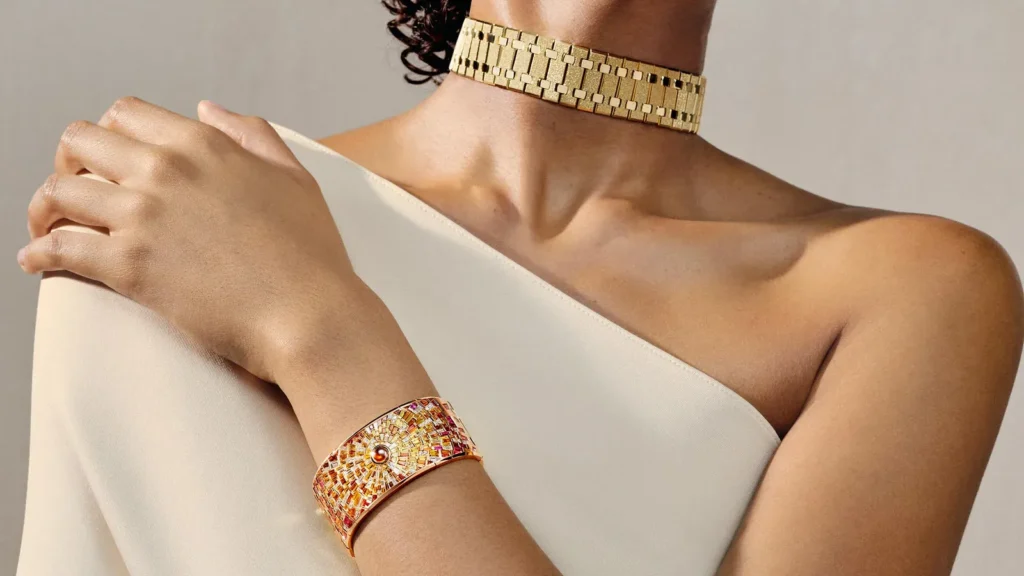
The collection’s cuffs take a more painterly approach to the Vallée de Joux, transforming its landscapes and natural imagery into gemstones: Blue Moon pairs white gold with sapphires and two shades of blue topaz; Frozen Lake recreates the brilliance of ice through diamonds, tsavorites, sapphires, and topaz; Tree of Life combines pink gold with 203 cognac-colored sapphires and more than 590 tsavorites; Blueberries introduces yellow-gold threads, amethyst, and black spinel cabochons; and Edelweiss is offered in white or yellow gold. The maison identifies Blue Moon and Sunburst as unique pieces, with Sunburst taking the most graphic approach through an 18-karat yellow-gold sunray radiating from an orange spessartite cabochon and extending through spessartites and yellow, orange, and pink sapphires. Two additional pairs of Dream of Joux drop earrings in 18-karat pink gold complete the offering, one combining tsavorites and topaz and the other bringing together pink sapphires, tourmalines, amethysts, and tanzanites.
The third chapter, Frosted Gold, may ultimately prove to be the most revealing. Three chokers and three cuffs are offered in 18-karat pink, white, and yellow gold under the names Autumn Mist, Spring Frost, and Summer Haze. Their distinctive texture originates from a 2016 collaboration between Audemars Piguet and jewelry designer Carolina Bucci, created for the 40th anniversary of the Royal Oak for women. Inspired by an ancient Florentine goldsmithing technique, the surface is formed by gently hammering the gold with a diamond-tipped tool, producing a finely textured brilliance that resembles a veil of diamond dust when contrasted with the collection’s mirror-polished studs and chamfers. Of all the creations, these six pieces perhaps communicate the collection’s central idea most directly. Dream of Joux naturally commands attention with its extraordinary diamonds and gemstones, but Frosted Gold captures the original concept in its purest form: the Royal Oak bracelet freed from the watch and worn purely as jewelry, while retaining a finish already deeply familiar to Audemars Piguet collectors.
A Jewelry Story Decades in the Making
Royal Oak Joaillerie may appear to represent a new direction, but jewelry has been part of Audemars Piguet’s story since the 19th century. The manufacture created pendant, brooch, and ring watches in collaboration with celebrated houses including Tiffany, Cartier, Oscar Heyman, and Bvlgari, while the 1929 “Tutti Frutti” watch featured a richly jeweled exterior created by Parisian jeweler Egouvillon Lafon & Cie. Jacqueline Dimier, the company’s first in-house designer, reinterpreted the Royal Oak for women in 1976 and subsequently developed accessories and jewelry inspired by the model. In the 1990s, Emmanuel Gueit continued that evolution alongside his work on the Royal Oak Offshore. Audemars Piguet established its own jewelry workshop during the 1980s, laying the groundwork for later creations including the Millenary Précieuse, the Haute Joaillerie collection introduced in 2013, Diamond Trilogy from 2015 to 2017, and Sapphire Orbe in 2019.
What makes Royal Oak Joaillerie different is not the maison’s return to jewelry, but its singular focus: a dedicated collection in which the movement disappears entirely and the Royal Oak itself becomes the object of desire. CEO Ilaria Resta describes the collection as a bridge between the manufacture’s past and future, reflecting a creative philosophy that uses jewelry to revisit established codes while expanding the possibilities of expression. Audemars Piguet positions the pieces as companions to its watches rather than substitutes, with the collection offered through selected AP Houses and boutiques, including locations in New York, Los Angeles, and Miami; prices have not been publicly announced. For more than five decades, the Royal Oak has challenged conventional ideas about luxury watchmaking, first proving that steel could possess the sophistication traditionally reserved for precious metals.
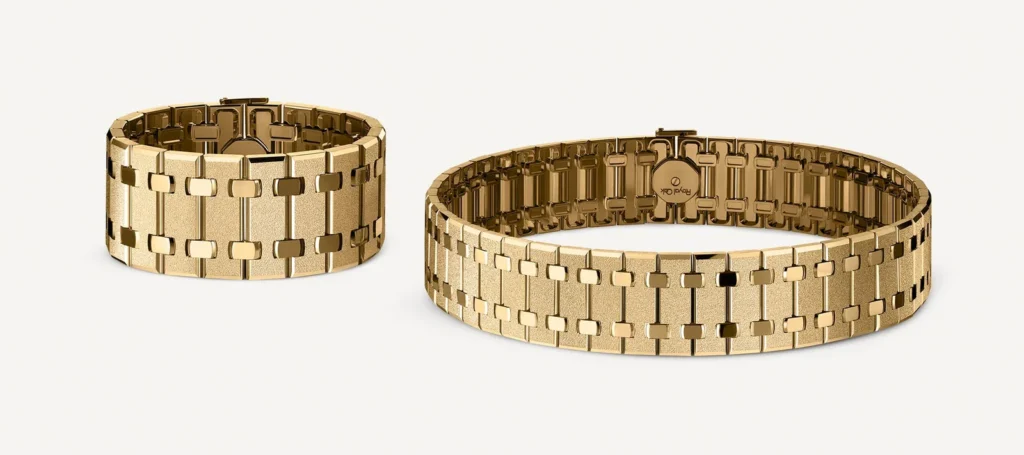
With Royal Oak Joaillerie, Audemars Piguet makes an equally compelling proposition: the watch can disappear, yet the icon remains. The bracelet no longer supports the timepiece it becomes the jewel.