
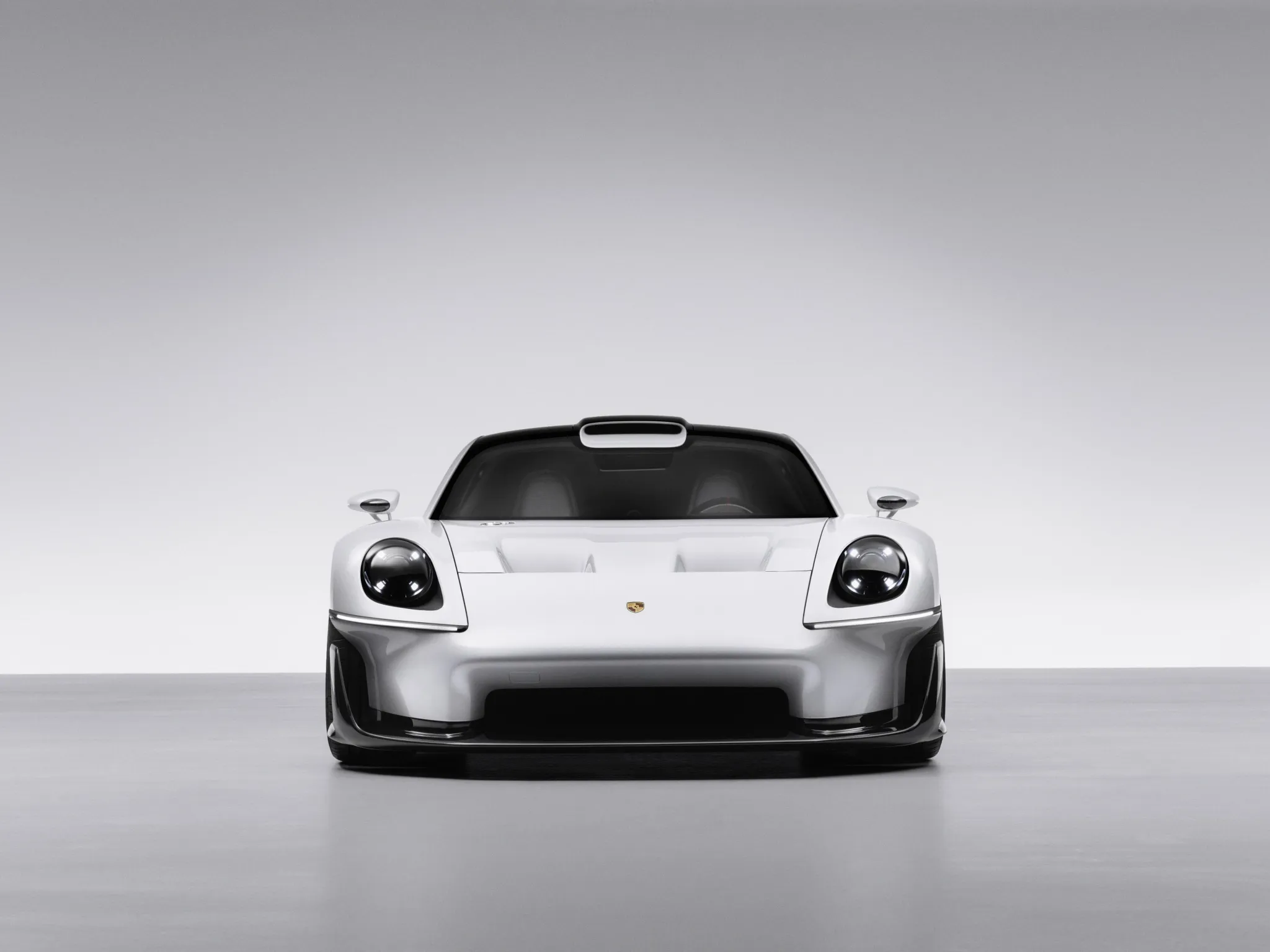
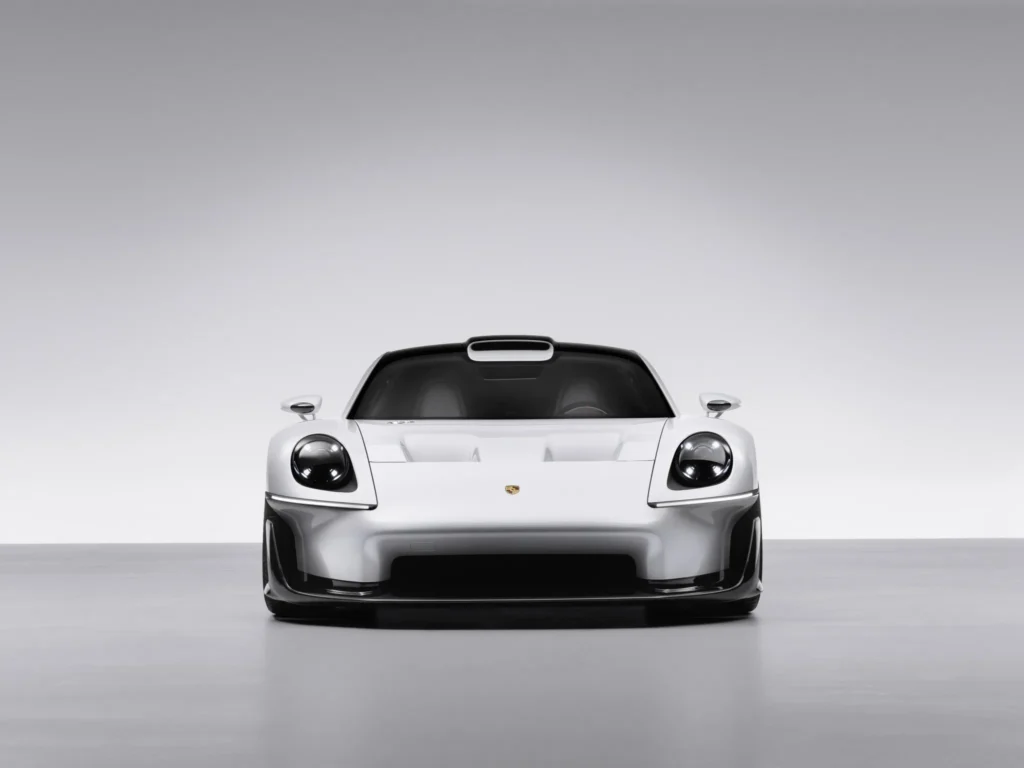
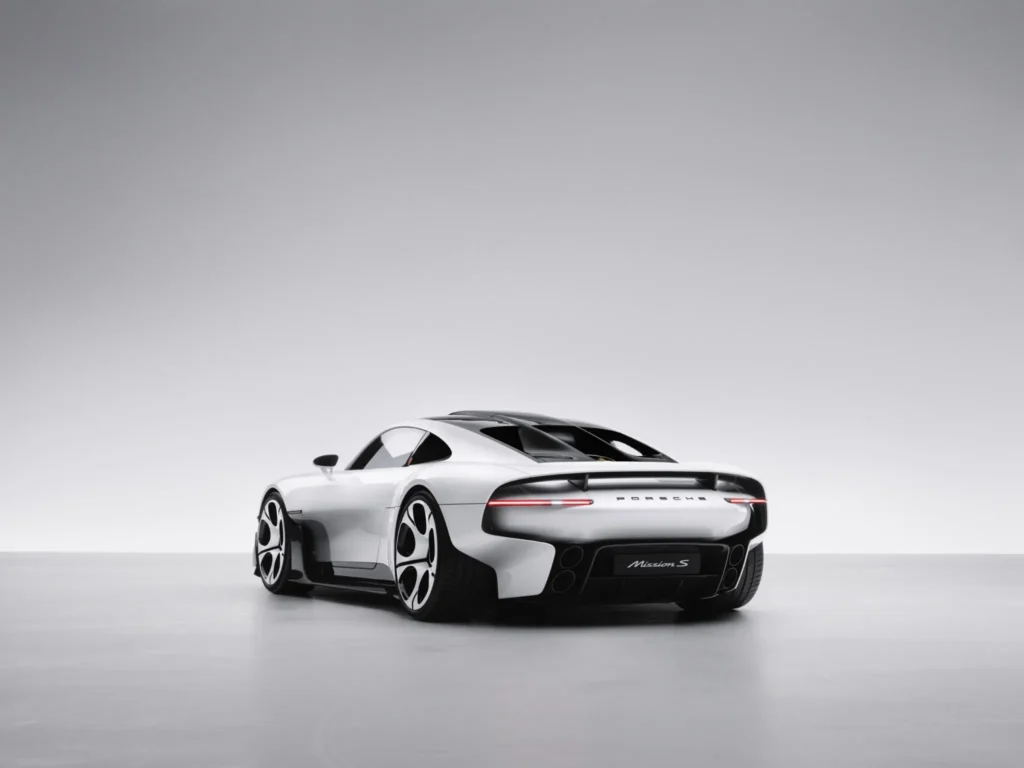
Porsche has unveiled the Mission S, a mid-engined, two-seat concept that signals the company’s intent to move beyond the 911 and into a new supercar class. The reveal took place in New York, and Porsche’s language suggests this won’t be a design exercise that stays on a show stand. Just as the Mission E previewed the Taycan, the Mission S points toward a production model.
Porsche described its plan as a “permanently available super sports car offer” positioned above the 911. Senior executives also confirmed to Hagerty that the car is headed for production. A mid-engined Porsche at this level would put the marque squarely against Ferrari. The Mission S was photographed on a Queens pier before its official debut, beside the 550 Spyder, Porsche’s first mid-engined sports car. The early glimpse may have softened the surprise, but not the significance: Porsche is preparing a new sports car that will sit above the 911 in both performance and price.
Beyond the “hypercar” label
Porsche has avoided calling the Mission S a hypercar. Dr. Michael Leiters, Chairman of the Executive Board of Porsche AG, has described it as “not as a one-off hypercar” wording that leaves room for a more exclusive, higher-priced model above it, potentially a successor to the 918. The distinction fits Leiters’ broader plan to reshape Porsche’s business. His strategy calls for lower production volumes and higher prices, with the aim of restoring stronger profitability. The Mission S, alongside any future limited-run flagships, could become a key part of that repositioning.
What might power it?
Porsche has yet to reveal what sits beneath the Mission S’s bodywork, and the company’s leaders are keeping quiet. The engine remains the biggest unknown.
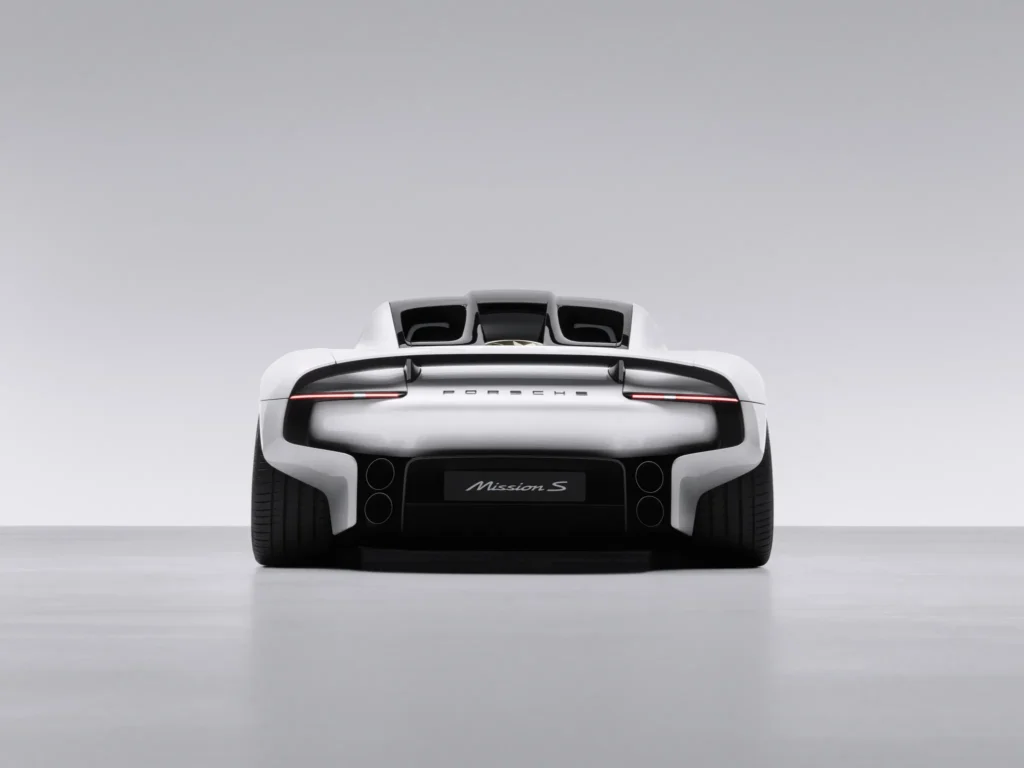
One intriguing possibility is a new flat-eight. Porsche-linked tuner RUF has developed such an engine for the CTR3 prototype shown at this year’s Goodwood Festival of Speed. The car’s rear engine cover stayed closed, giving rise to speculation about what lies beneath. RUF has denied plans to become an in-house Porsche division, along the lines of AMG at Mercedes-Benz or Alpina at BMW, but the engine has still fueled questions about the Mission S. The concept’s stacked quad exhaust outlets might suggest eight cylinders, although the rear diffuser could be difficult to package around a low-mounted boxer engine. Both details could change before production. Porsche could also adapt one of the 911’s most powerful engines, though a distinct engine layout would help set the mid-engined car apart.
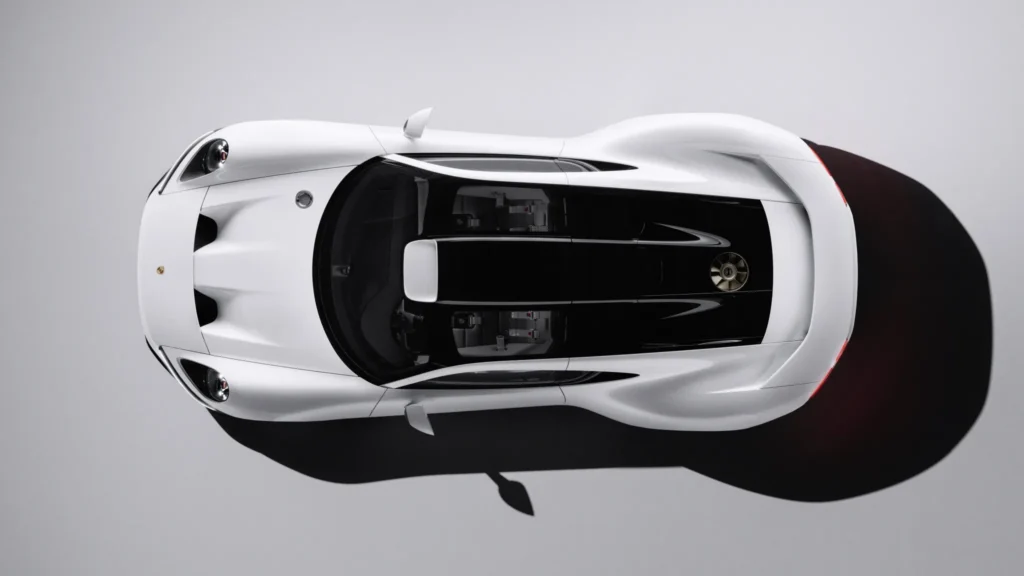
For a model intended to remain in production, hybrid assistance may be the more practical route as emissions rules tighten, particularly in Europe. Some high-end buyers, meanwhile, are showing renewed interest in naturally aspirated engines and manual gearboxes, as seen in the Gordon Murray S1 and McLaren McL 6GT. Leiters may choose to reserve those old-school features for rarer, more costly special editions.
Familiar Porsche cues, newly arranged
The Mission S is expected to share much of its underlying architecture with the 911. Its structure is said to combine steel, aluminum and carbon fiber rather than use a bespoke carbon-fiber tub.
A fan mounted in the engine cover recalls the cooling solution used on the Porsche 917, not the ground-effect fan of the Gordon Murray T.50. The Mission S is also the first design revealed under Tobias Sühlmann, Porsche’s new Head of Style. Rather than radically change the marque’s visual identity, Sühlmann has drawn on Porsche’s back catalogue. The sculpted front fenders are unmistakably Porsche. The low nose and rear bodywork evoke the late-1990s GT1, while the roofline carries a hint of the 959. The wheels nod to the 928’s distinctive phone-dial design. Together, the references create a cohesive shape, with a narrow waist and a more dramatic footprint than the 911.
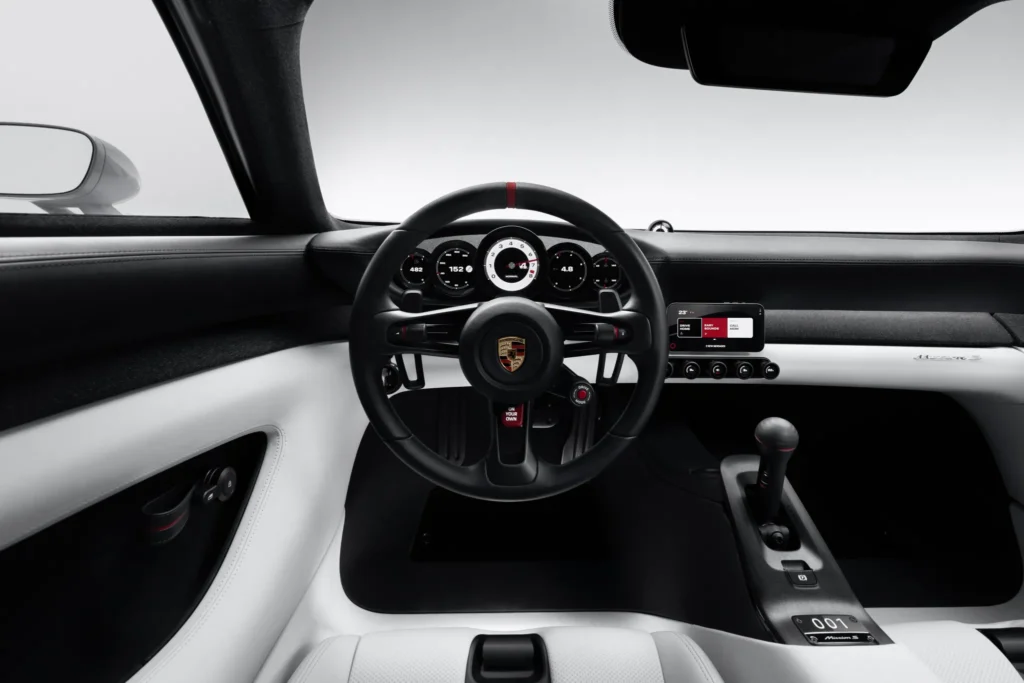
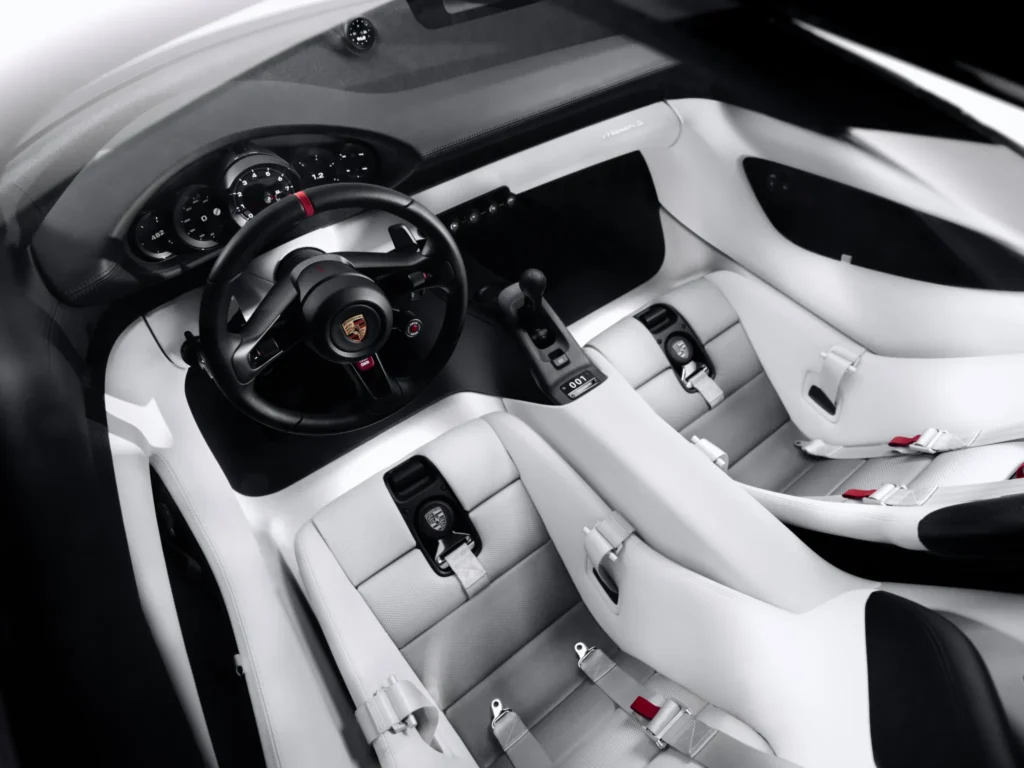
The interior follows a similar return to essentials. Porsche says the cabin is built around simplicity, clarity and intuitive controls a deliberate shift toward what it calls the fundamentals of sports-car engineering. Its layout draws inspiration from the 356 and 550 Spyder, with two strong horizontal lines stretching across the dashboard. Instead of a central touchscreen, the concept uses a MagSafe mount for the driver’s phone. The device handles navigation and can operate the car’s built-in functions through the My Porsche app. A digital instrument panel recreates Porsche’s familiar five-dial arrangement, with selectable designs inspired by different 911 generations.
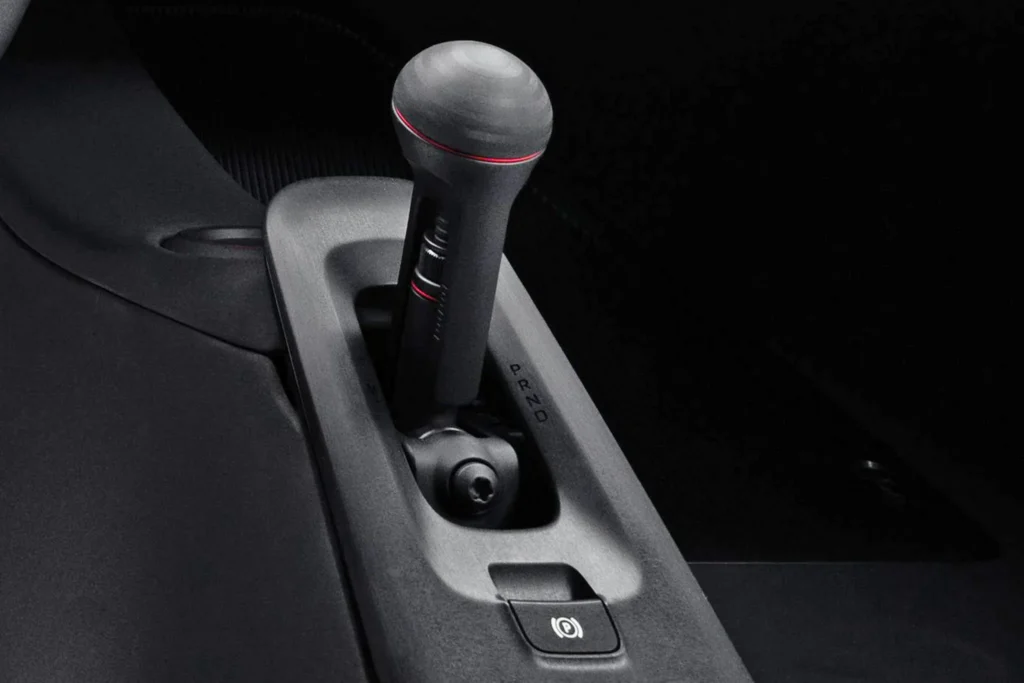
Physical controls remain part of the experience. New push-pull switches, styled like organ stops, operate comfort and driving functions. There’s also a key holder to the left of the steering wheel, recalling older Porsches even though a key is no longer needed to start the car.
A broader reset for Porsche
The production Mission S is expected to anchor Leiters’ “Sportwagenschmiede ’35” strategy—roughly, “sports car foundry.” The plan represents a shift from some of the direction set by his predecessor, Oliver Blume, who now leads Volkswagen Group. Porsche aims to reduce annual production by about a third, to roughly 200,000 vehicles. At the same time, Leiters wants to lift the average transaction price of the top 10,000 cars from €270,000 (about $303,000) to €330,000 (about $370,000).
The strategy puts more emphasis on sports cars and exclusive ownership experiences. Alongside the Mission S and a potential future hypercar, Porsche is considering more one-off and limited-run models through its Sonderwunsch (“special wish”) program, expanded customization on regular-production cars, and factory recommissioning for modern classics such as the Carrera GT. Leiters has also rejected the idea of adapting the upcoming electric 718 platform to accept a combustion engine, saying the result would be too compromised. The slow-selling Taycan may eventually be folded into the Panamera range. SUVs, however, will remain important to Porsche’s finances: the combustion-powered Macan is set to return, and a three-row model above the Cayenne is planned, primarily for the U.S. market.
The Mission S represents a bold attempt to change what Porsche builds and how it sells it. Whether that reset succeeds remains to be seen. As the plan’s most visible new sports car, the production Mission S could become both the defining symbol of Leiters’ leadership and its biggest test.