



Van Cleef & Arpels continues to evolve its Perlée universe with a new generation of rings crafted in gold, diamonds, and vibrant coloured gemstones, further refining its exploration of rhythm, repetition, and dimensional form through the signature bead motif.
At the heart of Perlée lies a single defining language: the gold bead. Rather than serving as ornament, it functions as a structural unit, repeated and multiplied to build rounded volumes that subtly respond to movement and light. Since its introduction in 2008, the collection has remained committed to this disciplined vocabulary, exploring variation not through new forms, but through the nuanced reconfiguration of a single element.

The latest Perlée rings extend this design logic through a heightened attention to proportion. Beads in yellow, rose, or white gold are arranged in three continuous rows that encircle the finger, shifting in scale as they move across the surface larger along the upper edge, gradually refining into smaller spheres beneath, creating a sense of quiet architectural flow.
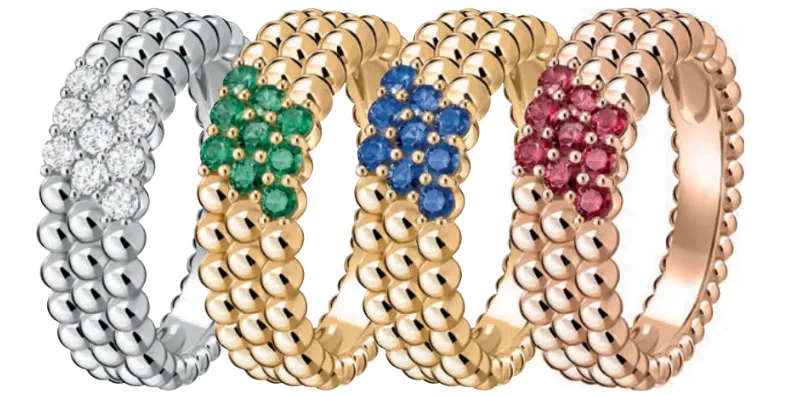
In select designs, a diagonal sequence of nine diamonds is set into the beaded structure, introducing a precise counterpoint of light. Each stone is carefully selected within exceptional parameters of quality D to F colour and IF to VVS clarity before being set using a refined nail technique. Rounded prongs echo the curvature of the beads, allowing the diamonds to sit seamlessly within the surface of the gold. As the ring moves, the diamonds no longer read as isolated points of brilliance, but as a continuous modulation of light woven into the rhythm of the piece.
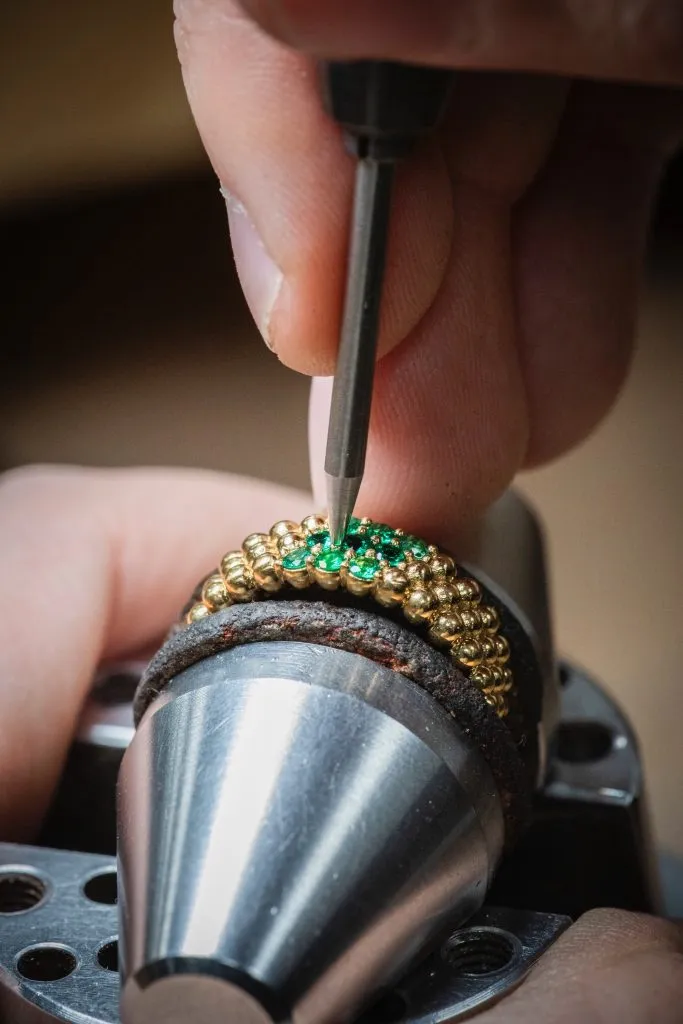
Alongside diamond-set variations, the collection introduces rings adorned with sapphires, emeralds, and rubies, integrated into the same beaded architecture. Each gemstone is chosen for its depth and consistency of colour—sapphire in intense saturated blue, emerald in vivid green, ruby in a deep, resonant red that becomes especially luminous against rose gold. Rather than interrupting the cadence of the beads, these stones are absorbed into the repetition, becoming part of its visual continuity.
The gold beads themselves are formed using the lost-wax casting technique, then meticulously refined by hand to achieve perfect uniformity in form. Each sphere is adjusted to ensure balance and consistency, preventing any single element from dominating the composition. Successive stages of polishing create a soft, diffuse lustre—less mirror-like shine than a gentle radiance that responds fluidly to light.
On the reverse side, a subtle honeycomb openwork structure is carved into the gold. Mostly concealed when worn, this internal architecture allows light to filter through the piece, intensifying its luminosity and enhancing the interplay between metal and gemstone. The setting follows the same design philosophy: rounded prongs mirror the bead motif, securing stones in close succession so that colour meets colour with minimal interruption.
The gold bead has been part of Van Cleef & Arpels’ creative vocabulary since the late 1940s, first appearing in pieces such as Couscous, where polished spheres were integrated into flexible Tubogas-inspired constructions. Even in these early expressions, the bead already functioned as more than decoration, contributing to both structure and kinetic presence. By the 1960s, the motif expanded into compositions incorporating coral, lapis lazuli, and turquoise, exploring contrast between uniform gold repetition and expressive natural colour. In later interpretations, including the Alhambra creations of the late 1960s, the bead evolved into more defined and symbolic arrangements, before being revisited again in the 1980s through increasingly geometric and abstract interpretations.

Since its formal introduction in 2008, Perlée has distilled this heritage into a single, coherent principle: a motif expressed through repetition, variation, and controlled precision. Worn individually, each ring presents a self-contained study in rhythm, material, and light. Styled together, the pieces begin to interact light slipping between beads, fracturing across diamonds, and deepening within coloured stones, creating a shifting choreography across the hand.