


In the year of its centenary, Bang & Olufsen chose not to look back but to look radically forward. The Danish maison marked 100 years of acoustic innovation by unveiling the Atelier Editions of its most uncompromising loudspeaker, the Beolab 90. The first chapter arrived quietly yet provocatively in the form of the Titan variant: a distilled interpretation of a $200,000 icon. It was a gesture that felt deliberately unconventional less commemorative trophy, more manifesto.
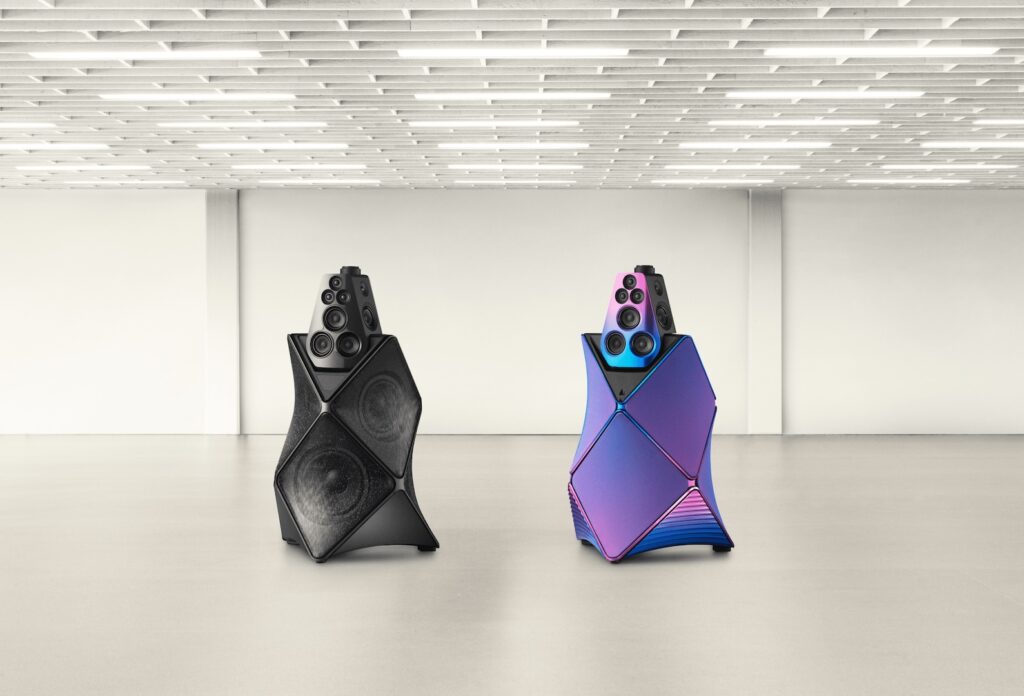
That debut was only the beginning. The Atelier series is limited to five editions, and with the unveiling of Editions Two and Three, Bang & Olufsen has made one thing clear: predictability has no place here. Enter the Phantom and the Mirage two opposing visions bound by the same formidable core.
The Art of Opposition
If the Phantom and Mirage share a language, it is spoken in contrast. The Phantom is restraint perfected. Draped in black PVD-coated stainless steel mesh, it reads as architectural and almost clandestine an object that commands attention by refusing spectacle. The semi-transparent skin creates what Bang & Olufsen describes as a “holographic depth,” allowing subtle glimpses of the 18 precision drivers beneath, like a supercar partially revealed under low light.
Carbon fiber hand laminated across the face mask, shoulder elements, and base introduces a motorsport tension, sharpened further by pearl-blasted anthracite aluminum details. The result is not decoration, but intent: a speaker that feels engineered rather than adorned. Power, expressed quietly.

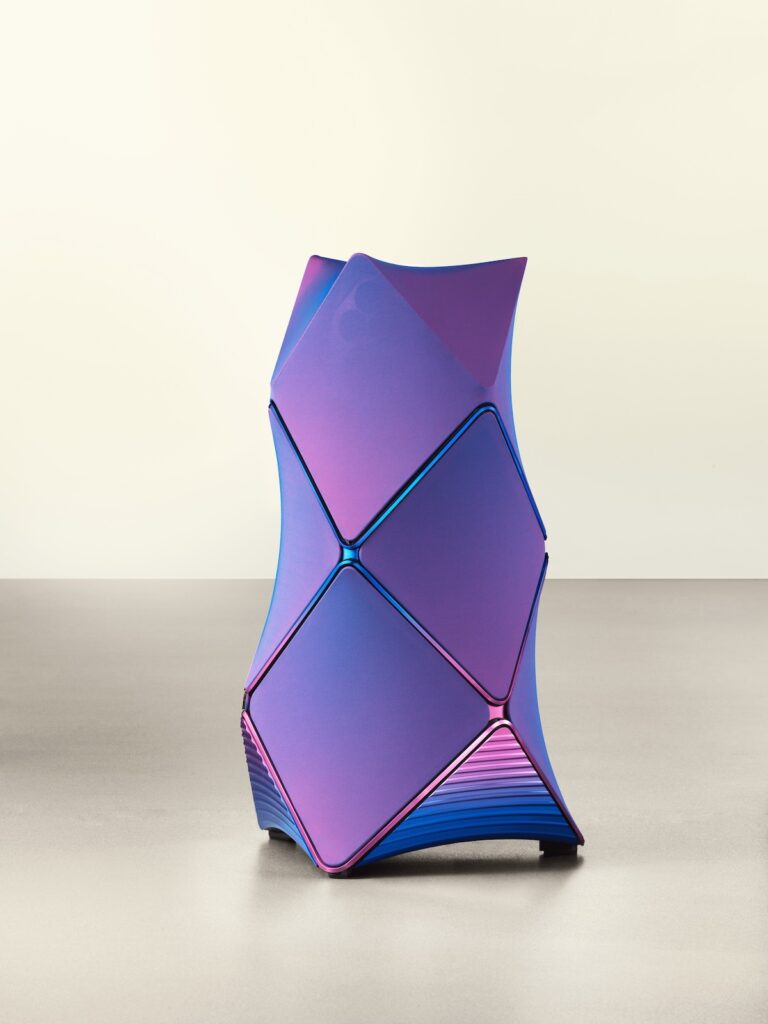
The Mirage, by contrast, is unapologetically expressive. Its surface becomes a canvas of movement, finished in gradient treated fabric that shifts from sapphire blue to magenta depending on light and perspective. Five aluminum components per speaker undergo painstaking hand polished anodization, their wave like textures conceived as a physical interpretation of sound in motion. It is theatrical, even daring but entirely appropriate at this altitude of design, where excess becomes a form of clarity.
Though their aesthetics diverge dramatically, both editions are the result of hundreds of hours of artisanal work at Bang & Olufsen’s Factory 5 in Struer, Denmark where craftsmanship still outweighs automation.
The Monument Beneath the Finish
At their core, the Phantom and Mirage remain unmistakably Beolab 90. First introduced in 2015 to celebrate Bang & Olufsen’s 90th anniversary, the speaker stands as one of the most ambitious undertakings in high-end audio.
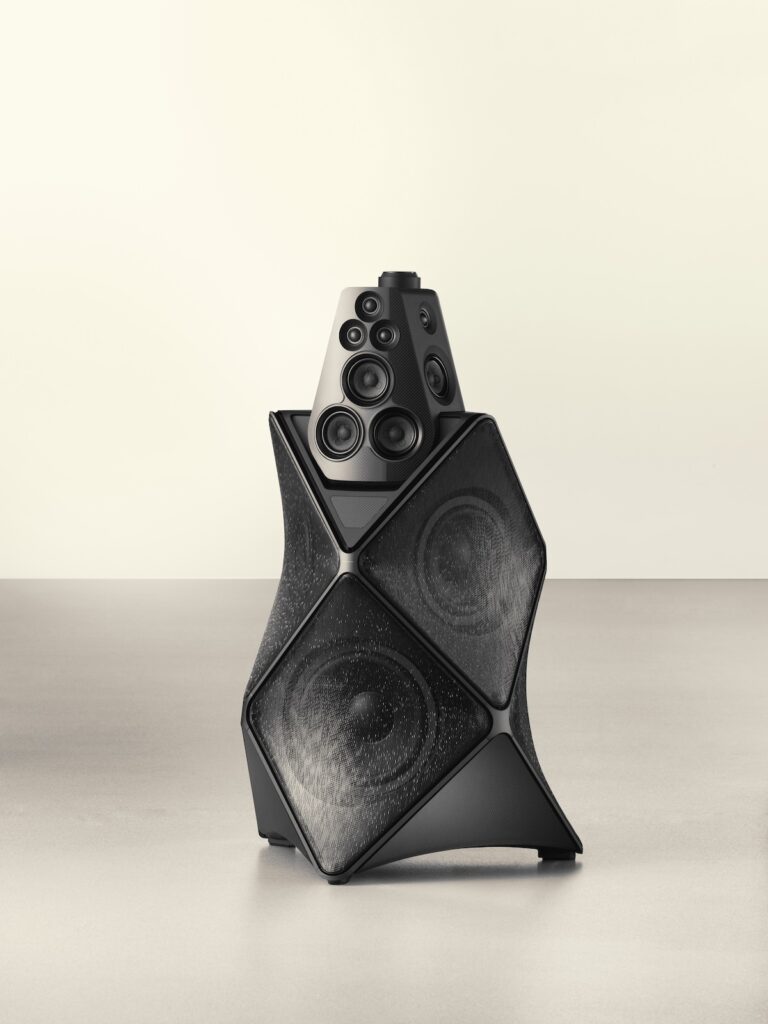
Each sculptural tower delivers 8,200 watts of output, distributed across 18 meticulously selected drivers: seven tweeters, seven midrange units, three woofers, and a commanding 13-inch front-facing bass driver. Power is managed by a complex architecture of 14 ICEpower amplifier channels alongside four Heliox Class D amplifiers. At over 300 pounds per speaker, the Beolab 90 is less an object you place—and more one you install.
What truly distinguishes it, however, is intelligence. Beam-forming technology allows the speaker to actively shape and direct sound, adapting to both room and listener. Active Room Compensation measures acoustics and recalibrates in real time, while Beam Width and Direction Control enable five distinct sound profiles transforming the listening experience from intimate to expansive at the touch of a command.

This is studio-level adaptability translated for the private residence provided, of course, that the residence is prepared to host something of this scale.
Beyond Celebration
With the Phantom and Mirage, Bang & Olufsen has resisted the temptation of nostalgia. These are not anniversary pieces in the traditional sense. They are declarations of confidence, of craftsmanship, and of a design philosophy unafraid of extremes.
As the Atelier Editions continue to unfold, one thing is certain: the Beolab 90 is no longer just a loudspeaker. It is a collectible instrument, a sculptural presence, and a reminder that in true luxury, contrast is not a contradiction it is the point.